
Elevating the online shopping ecosystem for small businesses

Improving Google Shopping to be a space where small businesses have the potential to truly thrive amongst larger competitors.

Role

Graduate Student (Capstone)

Industry

E-Commerce (B2B, B2C)

Duration

Apr-Jun, Sep-Dec (2024)

Team

4 UCSC graduate students + 1 Sr. UX Designer @ Google

This project is ongoing. Below is a case study on the research we've done — we're currently designing the final prototype. Check back in soon!

It's difficult for small businesses to grow and thrive in an online landscape dominated by large companies. Our goal was to determine how we could improve the online shopping ecosystem to better uplift small businesses in the online landscape.

It's difficult for small businesses to grow and thrive in an online landscape dominated by large companies. Our goal was to determine how we could improve the online shopping ecosystem to better uplift small businesses in the online landscape.

We explore how small business merchant and customer shopping journeys intersect, and gained valuable insights into the online shopping landscape. These findings offer key understandings that can help small businesses successfully reach and engage with customers online. Our ultimate goal is to help Google enhance the design and features of its Shopping platform to better serve small businesses.

We explore how small business merchant and customer shopping journeys intersect, and gained valuable insights into the online shopping landscape. These findings offer key understandings that can help small businesses successfully reach and engage with customers online. Our ultimate goal is to help Google enhance the design and features of its Shopping platform to better serve small businesses.

What will be the final deliverable?

Our goal is to understand the online shopping ecosystem and how we can improve it with Google's products. The final deliverable will be a prototype of a theoretical product for Google to implement.

Identifying key users in the online shopping ecosystem

We sought to study both merchants and customers (instead of solely merchants) to better understand customer behaviors and preferences in order to better inform merchants how they can succeed in tailoring their strategies to meet customer needs.

We sought to study both merchants and customers (instead of solely merchants) to better understand customer behaviors and preferences in order to better inform merchants how they can succeed in tailoring their strategies to meet customer needs.

🏪

🏪

🏪

Merchants

Consisting of small businesses in the existence phase, who are striving to establish their market presence. Merchants are often solopreneurs balancing many roles.

🛍️

🛍️

🛍️

Customers

Includes a diverse group of shoppers and includes nearly everyone who shops online. Customers cover a large spectrum of shopping behaviors and preferences.

What does the "online shopping" experience look like?
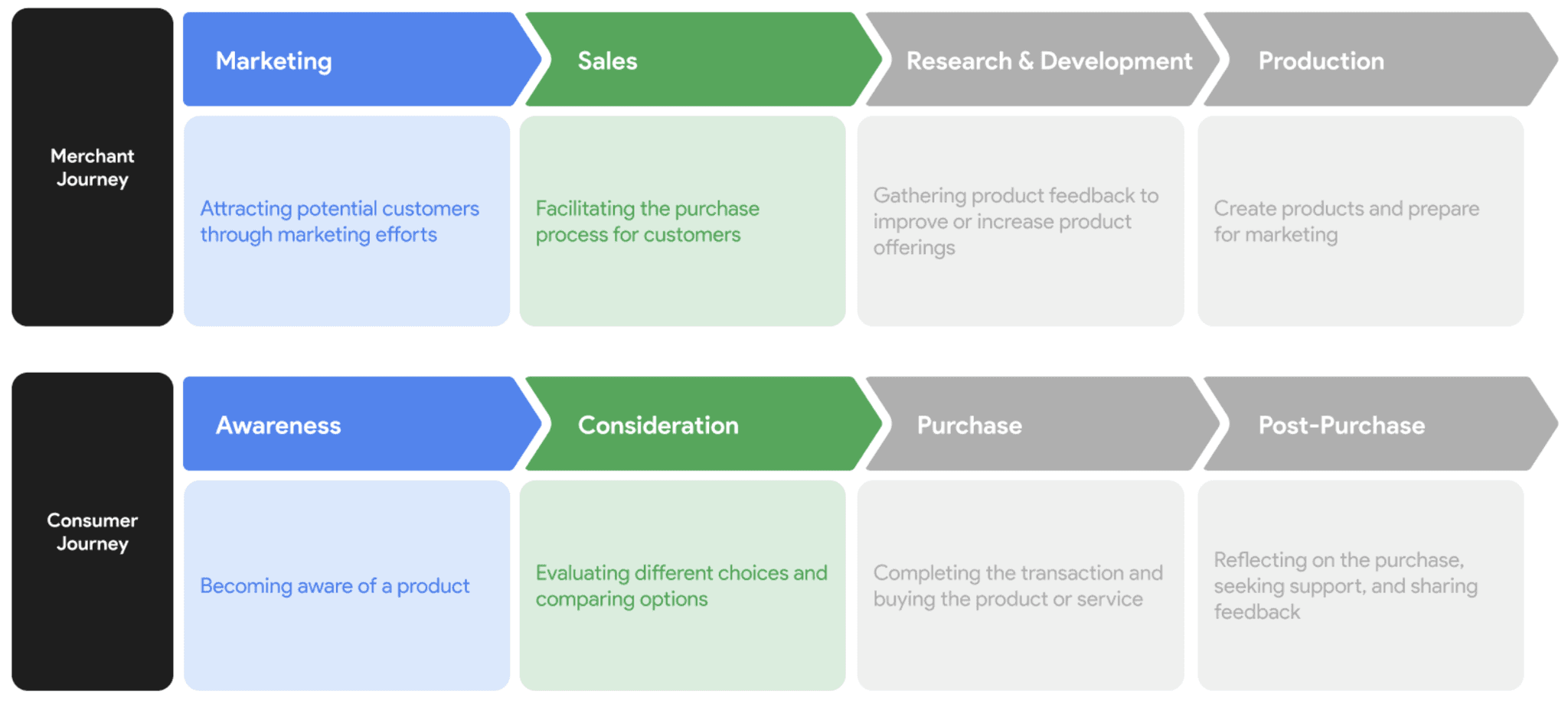
We found that initial trust plays a large role in helping consumers make their first purchase from an online merchant — thus, we wanted to focus on the parts of the journey that directly influence their initial trust: the very beginning stages.

We found that initial trust plays a large role in helping consumers make their first purchase from an online merchant — thus, we wanted to focus on the parts of the journey that directly influence their initial trust: the very beginning stages.

Google still has room to grow to help consumers become aware of and consider different small businesses in their purchasing decisions. With that, our core research questions were:

Google still has room to grow to help consumers become aware of and consider different small businesses in their purchasing decisions. With that, our core research questions were:

1

1

1

What are merchants currently doing to reach new customers?

2

2

2

What are merchants currently doing to build trust with customers?

3

3

3

How are customers currently finding small businesses online?

4

4

4

What are factors that help consumers validate their purchasing decisions?

We used multiple research methods to ensure a comprehensive understanding of merchants and customers

We sought to study both merchants and customers (instead of solely merchants) because we needed to understand customer behaviors and preferences in order to better inform how merchants can succeed in tailoring their strategies to meet customer needs.

We sought to study both merchants and customers (instead of solely merchants) because we needed to understand customer behaviors and preferences in order to better inform how merchants can succeed in tailoring their strategies to meet customer needs.

Consumers

For consumers, we utilized 4 different research methods to gain an understanding of their shopping behaviors and preferences:

📄

📸

📸

Survey (n=168)

To recruit for interviews and understand how consumers currently discover and verify online merchants

🗣️

🗣️

🗣️

Semi-structured interviews (n=12)

To expand on our survey findings to further understand how customers discover and verify small biz trustworthiness

🖥️

🖥️

🖥️

Usability testing (n=25)

To understand how customers currently navigate the Google Shopping platform and how their decision-making looks

👀

👀

👀

Contextual inquiry (n=8)

To observe how customers engage with online shopping in real-time, which helped us better understand their journey

Merchants

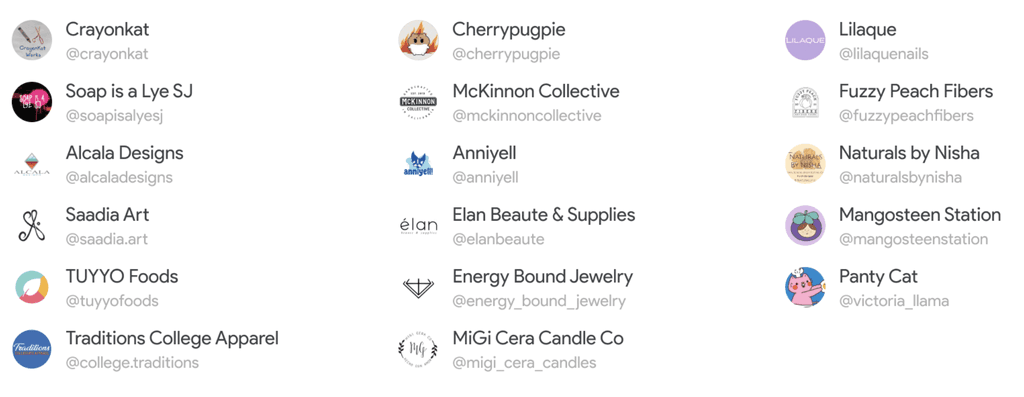
For merchants, we found 17 small businesses through Instagram or small business events and conducted:

🗣️

🗣️

🗣️

Semi-structured interviews (n=17)

To gain a deeper understanding of what merchants are currently doing to reach and engage with customers online
Why did we only conduct interviews for merchants?

This was due to a combination of balancing research needs and resource constraints (time & finances).
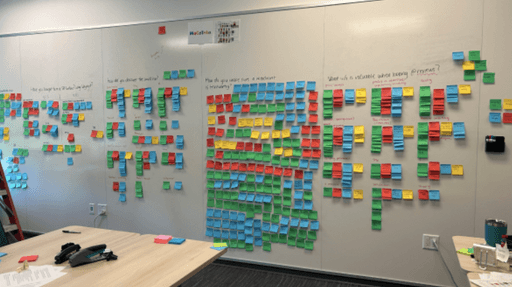

We sought to study both merchants and customers (instead of solely merchants) because we needed to understand customer behaviors and preferences in order to better inform how merchants can succeed in tailoring their strategies to meet customer needs.

We sought to study both merchants and customers (instead of solely merchants) because we needed to understand customer behaviors and preferences in order to better inform how merchants can succeed in tailoring their strategies to meet customer needs.

People love small businesses, but small businesses are at a disadvantage

😍 Uniqueness & values

Customers like unique products offered by small businesses, but are cautious to trust them

🪫 Limited resources

Small businesses want to earn the trust of customers, but face resource limitations

📉 Ineffective strategy

Engagement strategies that small businesses use are ineffective at yielding their intended results

Many of the customers we interviewed shared a common sentiment: that they love small businesses. Customers recognize their value, appreciate the uniqueness of their products, and enjoy supporting their community. However, because small businesses are lesser known brands, customers are cautious to trust them — especially when shopping online.

Many of the customers we interviewed shared a common sentiment: that they love small businesses. Customers recognize their value, appreciate the uniqueness of their products, and enjoy supporting their community. However, because small businesses are lesser known brands, customers are cautious to trust them — especially when shopping online.

Small business merchants often have limited resources to expand their business and are at a disadvantage compared to larger, more resourced businesses. Many merchants we interviewed are still learning the ropes of appealing to customers online, which can be costly and time-consuming.

Small business merchants often have limited resources to expand their business and are at a disadvantage compared to larger, more resourced businesses. Many merchants we interviewed are still learning the ropes of appealing to customers online, which can be costly and time-consuming.

"Without a budget, like a marketing budget, reaching people organically is almost impossible."

Participant M09

Merchant

Because merchants are trying to find the best way to grow their business via trial and error, the strategies they use are often ineffective at yielding their intended results.

Because merchants are trying to find the best way to grow their business via trial and error, the strategies they use are often ineffective at yielding their intended results.

Example #1

Example #1

Merchants view ads as one of the best ways for them to reach customers, sometimes citing it as the only marketing strategy they know. However, almost all of the customers we interviewed tend to avoid overt ads, finding them annoying and unhelpful.

Merchants view ads as one of the best ways for them to reach customers, sometimes citing it as the only marketing strategy they know. However, almost all of the customers we interviewed tend to avoid overt ads, finding them annoying and unhelpful.

Example #2

Example #2

Customers value relatable social media content, which helps them to build trust with the business over ads. However, many of the merchants we interviewed don't know how to make social media content that best appeals to customers.

Customers value relatable social media content, which helps them to build trust with the business over ads. However, many of the merchants we interviewed don't know how to make social media content that best appeals to customers.

Problem

Small businesses have great potential, but the merchants' impacts don't meet this potential
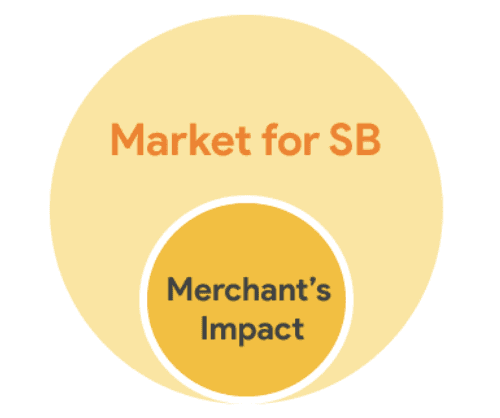
Customers love small businesses, but merchants are ineffective when it comes to figuring out how to reach and engage them online, usually due to their inexperience and limited resources. Especially when it comes to small businesses, customers express that they require more trust signals in order to facilitate a purchase.

Given these circumstances, we've concluded that fostering trust is crucial for small business owners to close the gap between their potential and their impact, and successfully meet customer needs and expectations.

Customers love small businesses, but merchants are ineffective when it comes to figuring out how to reach and engage them online, usually due to their inexperience and limited resources. Especially when it comes to small businesses, customers express that they require more trust signals in order to facilitate a purchase.

Given these circumstances, we've concluded that fostering trust is crucial for small business owners to close the gap between their potential and their impact, and successfully meet customer needs and expectations.

Solution

Small businesses need ways to build trust with their customers

Fostering trust is crucial for small business owners to close the gap between their potential and their impact, and successfully meet customer needs and expectations. Trust enables customers to progress from one stage of the shopping journey to the next.

Fostering trust is crucial for small business owners to close the gap between their potential and their impact, and successfully meet customer needs and expectations. Trust enables customers to progress from one stage of the shopping journey to the next.

"

"

Trust bears important functions for the customer — it reduces information complexity and lowers the perceived risk of a transaction.

Trust bears important functions for the customer — it reduces information complexity and lowers the perceived risk of a transaction.

"Trust bears important functions for the customer — it reduces information complexity and lowers the perceived risk of a transaction."

The Online Shopping Trust Framework — understanding what customers need to trust a small business
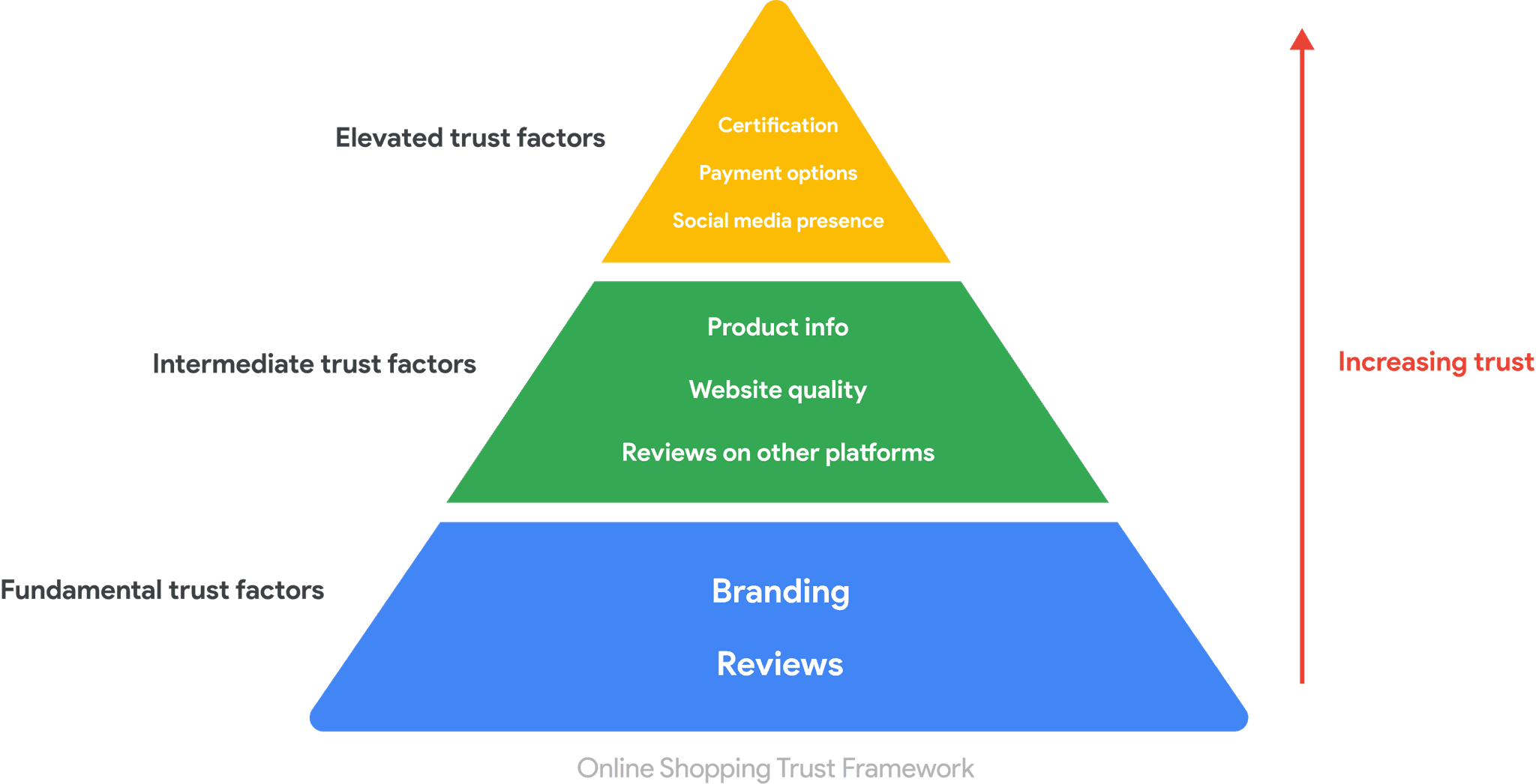
We developed a framework as a result of our research findings, which defines what we believe to be factors that customers need from merchants in order to gain their trust when shopping online, especially for small businesses that don't already have a reputation.

We developed a framework as a result of our research findings, which defines what we believe to be factors that customers need from merchants in order to gain their trust when shopping online, especially for small businesses that don't already have a reputation.

Part 1 of 2

Breaking down the framework: the intermediate & elevated needs of customers
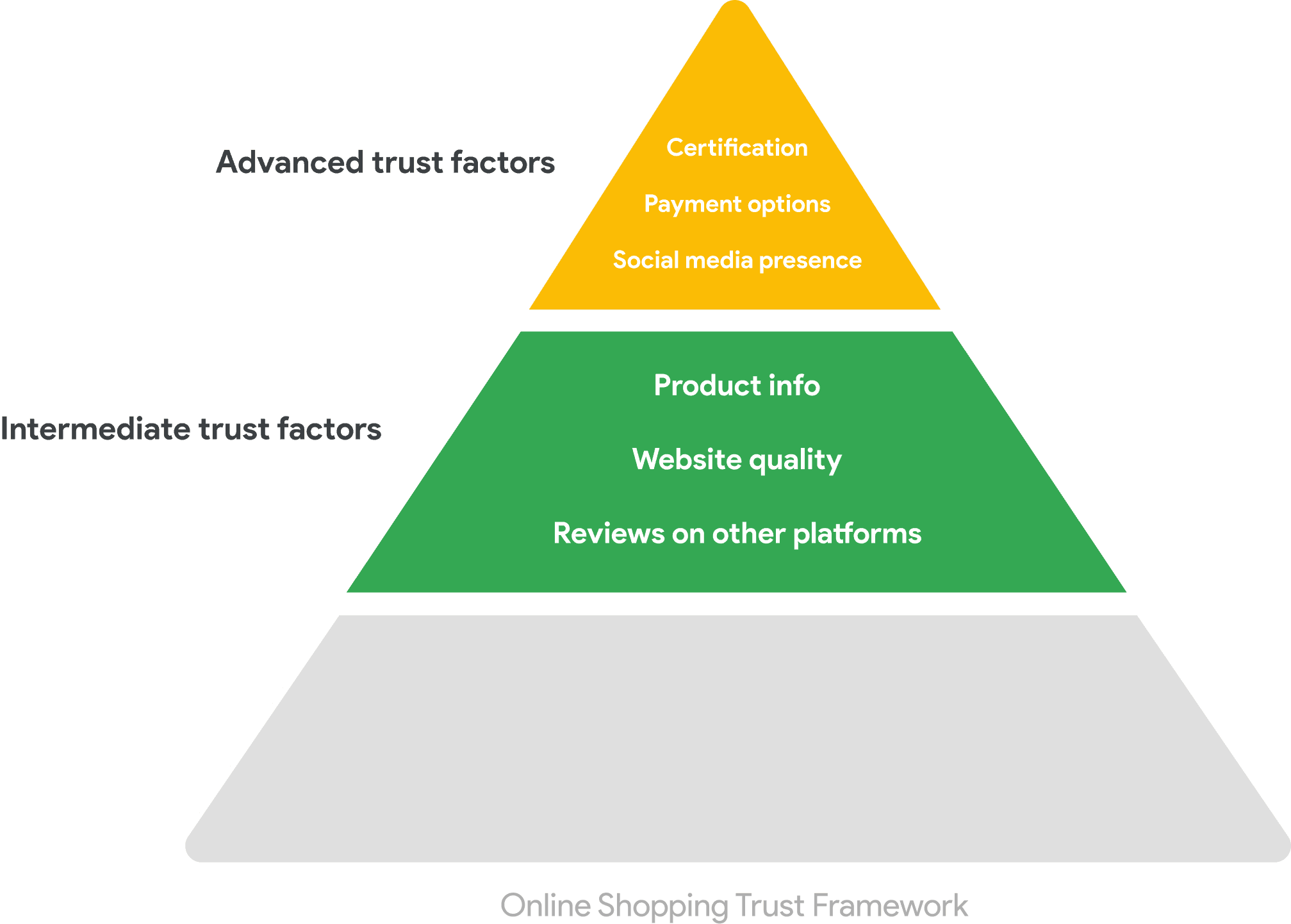
As merchants go up the pyramid, they address an increasingly niche subset of consumers. Consumers who consider these factors will likely also consider the factors that come before it. For example, a consumer that considers the advanced trust factors will likely also consider the intermediate and fundamental trust factors.

As merchants go up the pyramid, they address an increasingly niche subset of consumers. Consumers who consider these factors will likely also consider the factors that come before it. For example, a consumer that considers the advanced trust factors will likely also consider the intermediate and fundamental trust factors.

Part 2 of 2

Breaking down the framework: the fundamental needs of customers
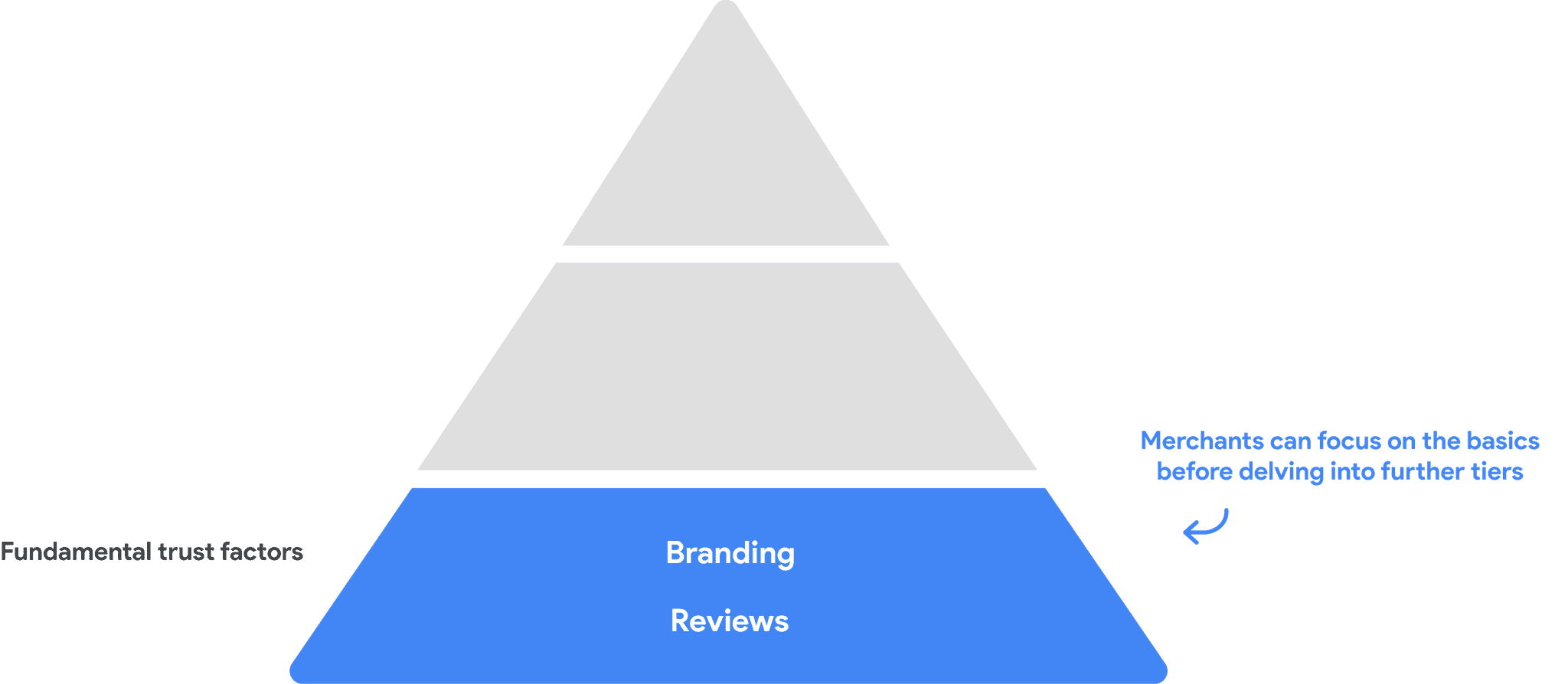
Across a wide range of consumer preferences, we found that all types of consumers share these fundamental trust factor basic needs: branding and reviews.

Across a wide range of consumer preferences, we found that all types of consumers share these fundamental trust factor basic needs: branding and reviews.

Branding

Branding

Branding is defined as what distinguishes a merchant's products, values, and identity. Customers expressed that when shopping small, they evaluate the branding of both the product and the merchant. Merchant branding can consist of visual appeal (ex. website) and positive customer engagement.

Branding is defined as what distinguishes a merchant's products, values, and identity. Customers expressed that when shopping small, they evaluate the branding of both the product and the merchant. Merchant branding can consist of visual appeal (ex. website) and positive customer engagement.

Reviews

Reviews

Consumers heavily depend on reviews, but don’t leave reviews themselves, despite how important it is to them to have. Merchants should prioritize receiving reviews since it helps consumers to trust them; the merchants we interviewed expressed not prioritizing setting up review system if they don’t already have one.

Consumers heavily depend on reviews, but don’t leave reviews themselves, despite how important it is to them to have. Merchants should prioritize receiving reviews since it helps consumers to trust them; the merchants we interviewed expressed not prioritizing setting up review system if they don’t already have one.

"I don’t leave reviews... which is probably hypocritical since I just mentioned how important they are for me. I only leave them when there’s an incentive."

Participant C11

Customer

How can we facilitate trust-building into the design of Google Shopping?

Text about what we hope to design and how it connects to our research

Text about what we hope to design and how it connects to our research

🖥️

🖥️

🖥️

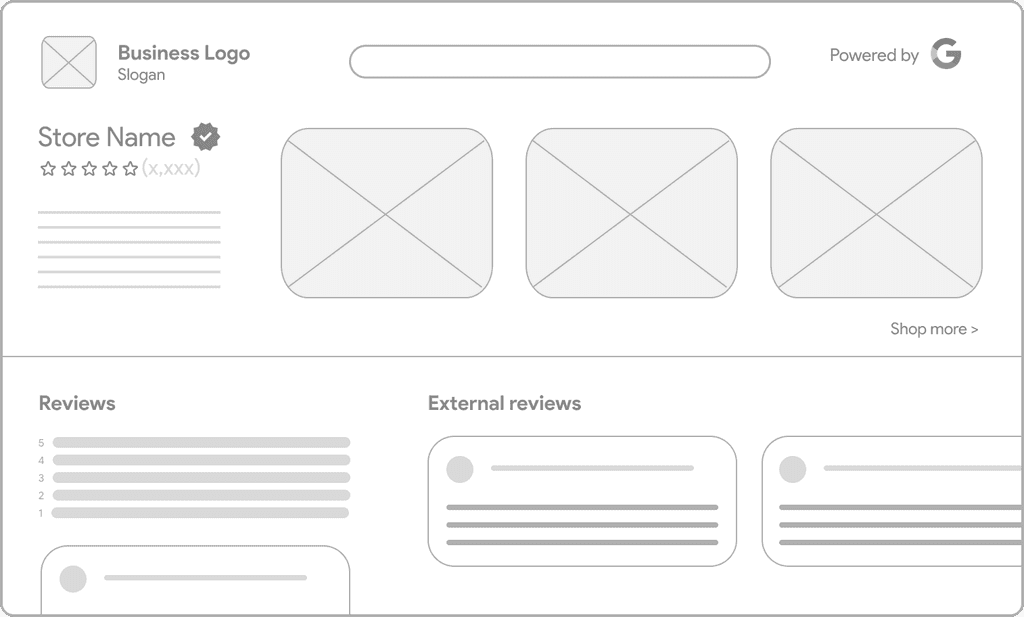
A business storefront, hosted on Google Shopping

The Online Shopping Trust Framework identifies key factors for building customer trust. By integrating these within Google’s platform, shoppers can access all the necessary trust-building elements in one place, streamlining the process and eliminating the need for external verification.
✍️

✍️

✍️

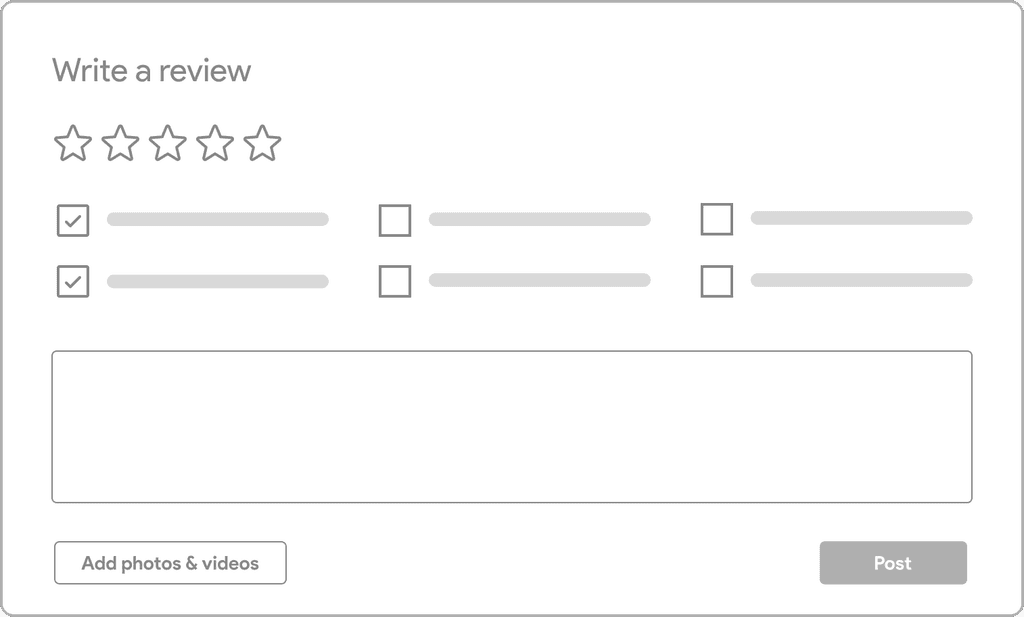
An interactive and motivating review module

Reviews play a critical role in customers' decision-making, making it vital for merchants to receive them to build trust. We're exploring ways to help users write high-quality reviews and to enable merchants to integrate review systems into their storefronts.

Our capstone team is in the last sprint of our project. We are in the midst of designing our prototype and testing it with users. Our project is set to be complete by early December 2024!

Our capstone team is in the last sprint of our project. We are in the midst of designing our prototype and testing it with users. Our project is set to be complete by early December 2024!

In the meantime, here are some more pictures of my lovely capstone team ✨

In the meantime, here are some more pictures of my lovely capstone team ✨

Due to privacy reasons, I am unable to publicly share the work that I completed at CNN. However, I'll share an overview of my project and some takeaways. I'm able to share more details about the designs and my process in an interview call. For now, you'll just have to trust that I got to work on some awesome stuff during my time at CNN!

I was a Product Design Intern on the Audio/Video team, where I designed a first-of-its-kind "Save" feature, which allows users to save videos and audio clips/podcasts to their CNN account library. I was able to take ownership of the entire design process of this feature, from research to preparing a document for developer hand-off.

I'm excited to be returning to CNN as a Product Design Intern in the fall of 2024! I'll be working on their desktop website, which sees millions of unique monthly site visits. ✨

During my time at CNN, I…

💻

💻

Designed for multiple interfaces: mobile, desktop, and TV

I had the unique opportunity to design this feature across multiple platforms, including CNN's mobile app, mobile site, desktop site, and TV app available on smart TVs.

🔨

🔨

Navigated complex design constraints

Designing for a large organization like CNN means working within design and business constraints. I managed to navigate these challenges and designed something that was both innovative and feasible.

📝

📝

Worked with existing design systems

I gained valuable experience navigating and working with extensive documentation at a large organization like CNN, which involved understanding how to maintain consistency across multiple ongoing projects.

👩‍💻

👩‍💻

Designed and facilitated an unmoderated usability test

To validate the need for the feature and the initial designs, I conducted a study using UserZoom and analyzed data from 12 users to assess the business impact and confirm the effectiveness of my designs.

💼

💼

Collaborated with product designers of all levels

I had the pleasure of collaborating with product designers at all levels, from junior to senior, staff, and management.